
Using Objects to Develop the Narrative of Anne Boleyn: her age, possible guilt and legacy as evidenced by a Letter, a Handkerchief and a Tablecloth
Valerie Shrimplin *
1Independent Art Historian, Honorary Senior Research Associate Gresham College (2018), England, U. K .
A vast amount has been written about Anne Boleyn (1501/07-1536) and her relationship with Henry VIII (1491-1547), particularly concerning her role in Henry’s quest for a male heir and whether she is to be regarded as ‘harlot or heroine’. Yet some key questions surrounding Anne’s life and her relationships with Henry VIII and Elizabeth I are still not completely resolved.Amongst the most significant are: her age and precise date of birth; whether she was ‘guilty as charged’ of adultery or not; andher legacy and impact on her daughter, Queen Elizabeth I. This paper takes a new approach to these issues by investigating not only written historical sources but the role of particular objects that can be used to add to the continuing debate. Examination of actual artefacts is important in historical research as well as written material. The items considered hereare:an undated Letter on which the dating of Anne’s birth rests; the Handkerchief that Anne gave her alleged lover in May 1536 suggesting a link to Shakespeare’s Othello; and a Tablecloth featuring Anne’s symbol of a falcon made in 1571. The paper discusses the likely validity of three distinct but overlapping argumentsrelated to these objects, demonstrating that these questions are worthy of continued further investigation. It also, and more significantly in terms of historiography and the history of objects in the early modern period, demonstrates the value of material evidence.
Copy the following to cite this article:
Shrimplin V. Using Objects to Develop the Narrative of Anne Boleyn: her age, possible guilt and legacy as evidenced by a Letter, a Handkerchief and a Tablecloth. Current Research Journal of Social Sciences and Humanities. 2026 9(1).
Copy the following to cite this URL:
Shrimplin V. Using Objects to Develop the Narrative of Anne Boleyn: her age, possible guilt and legacy as evidenced by a Letter, a Handkerchief and a Tablecloth. Current Research Journal of Social Sciences and Humanities. 2026 9(1). Available here: https://bit.ly/4duFL9E
Citation Manager Review / Publish History

Introduction
The saga of Henry VIII (1491-1547) and Anne Boleyn (1501/07-1536) has probably been studied academically and discussed casually more than any other royal pairing. A vast amount has been written on Anne Boleyn as probably the best-known crowned Queen consort ever, and her fate as the wife of the turbulent Henry VIII is familiar the world over. Debate continues over her role in Henry’s endless quest for a healthy male heir, and whether Anne is to be regarded as ‘harlot or heroine’ –a scheming, ambitious, immoral temptress or the highly educated mother of England’s greatest ruler? Or both? (Ives, 2008; Norton, 2013; Starkey, 2004; Warnicke, 2009).
Innumerable academic tomes and popular historical novels have been written about Anne Boleyn but some great unanswered questions remain. Foremost, and perhaps amongst the most significant are: Anne Boleyn’s age and precise date of birth; whether Anne Boleyn was ‘guilty as charged’ of adultery or not; and the legacy and impact of Anne Boleyn on her daughter, Queen Elizabeth I. By using objects to develop the story of Anne Boleyn , as well as written historical sources, it seems possible to unravel some of the curious mysteries about Anne, providing answers to these great imponderables. A Letter on which the dating of Anne’s birth rests will first be considered; followed by a possible Shakespearean link to the story of the Handkerchief that Anne supposedly gave to her lover; and, lastly, the significance of a Tablecloth featuring the symbol of a falcon in 1571.
Materials and Methods
The current paper focuses on the detailed consideration of artefacts relating to Anna Boleyn and her early life at Hever (as shown in her writings), a documented reference to a gift of a handkerchief, and a tablecloth made by Sir Thomas Gresham for her mother, Queen Elizabeth I. These materials were individuals considered in terms of their creation and significance, then brought together to show how the use of historical artefacts can contribute most significantly to the interpretation of historical themes and events. Examination of the relevant artefacts was carried out by the author, in the context of existing references in primary and secondary sources, in order to formulate and check important hypotheses regarding a number of great ‘unknowns' relating to Henry VIII’s second wife: the date of birth of Anne Boleyn, the reasons for her downfall, and her legacy and influence on her daughter Queen Elizabeth I.
Results
The results of the investigation show that detailed consideration of artefacts can contribute to, if not direct, lines of enquiry that can add to, if not solve, continued discussion and reasonable speculation on important debates surrounding key historical figures. The study demonstrates the value of material evidence, and shows that key issues in the story of Anne Boleyn would benefit from continued discussion and investigation.
Discussion
The Letter as indictive of Anne Boleyn’s Date of Birth
Anne Boleyn’s precise date of birth is unknown, but her age is highly significant in terms of considering whether, when she first met and became involved with Henry (from 1522), she was already a mature woman or an inexperienced girl in her late teens. There has been a vast amount of discussion over Anne’s age and date of birth that need not be repeated in detail here, including popular websites (The Anne Boleyn Files, n.d.), (On the Tudor Trail, n.d.)(The Tudor Society n.d.), (Gareth Russel, n.d.). Briefly, for many centuries, her year of birth was normally given as 1507 in accordance with various written sources. More lately, others have argued for 1501.
Jane Dormer (1538-1612), lady-in-waiting to Mary Tudor, wrote in her memoirs (as dictated to her secretary Henry Clifford) that ‘She [Anne] was not yet twenty-nine years of age’ when she was convicted and condemned (Clifford, 1887). Anne was executed on 19 May 1536, thus giving her latest possible birthdate as 18 May 1507. This information was likely received by Jane Dormer from Mary Tudor who would have no reason to give her hated stepmother an incorrect date of birth to make her seem younger. The 1507 date was also cited later in the sixteenth century by the scholar William Camden (1551-1623) who was tasked to write a chronicle of the life and reign of Elizabeth I by Elizabeth’s chief minister and adviser, William Cecil Lord Burghley. Camden was allowed access to Burghley’s papers and categorically states that Henry fell in love with Anne Boleyn when he was aged thirty-eight and Anne was twenty-two. Since Henry (b June 1491) turned thirty-eight in 1529, this also gives Anne’s year of birth as 1506 or 1507 (her birth month is unknown). Camden also noted Anne Boleyn’s year of birth in the margin as ‘MDVII’ (1507) (Camden, 1615).1
In contrast to Anne’s precise date of birth, her education in a range of French speaking courts and households on the continent is more extensively documented. Evidence suggests that Anne first travelled overseas in 1513, to the court of Margaret of Austria, as a sort of finishing school in the Netherlands. Then, by 1515, she moved on to join the household of Queen Claude of France, returning to England in 1522 (Ives, 2008; Starkey, 2004). A birth date of 1507 would mean that she was very young, about six years old, when she first went overseas, and that she went on to France at the age of about nine or ten. This does seem young, yet Margaret of Austria herself wrote of Anne: ‘I find her so bright and pleasant for her young age that I am more beholden to you for sending her to me than you are to me’ making it clear that she was younger than normal to join the Netherlandish Court. Cavendish (biographer of Wolsey) also emphasised how young Anne was when she was sent overseas (‘This gentlewoman, Mistress Anne Boleyn, being very young, was sent into the realm of France’).
Anne’s father described her as ‘La Petite Boulain’ in 1514, suggesting a small child in an age when a thirteen-year-old (if Anne’s year of birth was 1501) was almost considered adult in terms of consummated marriage (Warnicke, 2009). Warnicke furthermore demonstrates that although Anne was younger than usual for a position of maid of honour, it was very likely that she was placed in a separate household as schoolroom companion to the Royal children. Another English girl, Anne, daughter of Henry’s friend Charles Brandon was there at the same time, whose date of birth is normally given as 1506 (Warnicke, 2009). It was unusual to have someone so young at Margaret’s Court but not completely impossible (Mary Queen of Scots spent 13 years at the French Court from the age of five, 1548-61). It should also be noted here that Anne Boleyn’s daughter Elizabeth had some proficiency in Latin, French and Italian by the age of ten, which seems to be in line with the early skills and education of her mother.
In spite of these arguments in favour of a birthdate of 1507, it has also been claimed that an earlier birthdate could be possible. In 1981, Hugh Paget refuted the long-held contention for 1507, asserting an earlier birthdate of 1501 (Paget, 1981). Paget dates the letter as 1514 on the grounds that it was written in French from Veuve but it is actually undated. The arguments for both dates are exhaustive (and exhausting) and need not be repeated or summarised in full here.
Briefly, Paget refers to the argument for 1507 as being based on Camden’s Annales, but he does not mention Jane Dormer at all. He rather emphasises ‘the statement of Nicholas Sanders [sic] made in 1585 that she was in her fifteenth year when she went to France (Sander, 1585).2 This would indeed have given Anne a birthdate of 1500-01, but Nicholas Sander (who was fiercely Catholic, anti-Protestant and anti-Anne Boleyn) also claimed that Anne was actually the result of a liaison between Henry VIII and Lady Elizabeth Boleyn, Anne’s mother. Henry, born June 1491, was just ten years old in 1501, which clearly puts into doubt Sander’s whole chronology.
Paget then discusses a range of comments by nineteenth-century historians, focussing on ‘an early letter of Anne, written to her father (Paget, 1981, 164, n10). A key factor that seems to need further investigation is the way in which the argument for 1501 is based on this letter (Figure 1). . Paget presents a transcription and translation of the letter (written in French) but not an image of the letter itself. He observes the sign-off as ‘scripte a Veure’ (the Royal Park at Brussels, now known as Terveuren), but concedes that others have interpreted this as meaning ‘at Hever’, or even ‘at five o’clock’ (a V heures). On this evidence, he dates the letter as written in 1514 when Anne was at the Court of Margaret of Austria in the Netherlands (Figure 1) (Ives, 2008).3
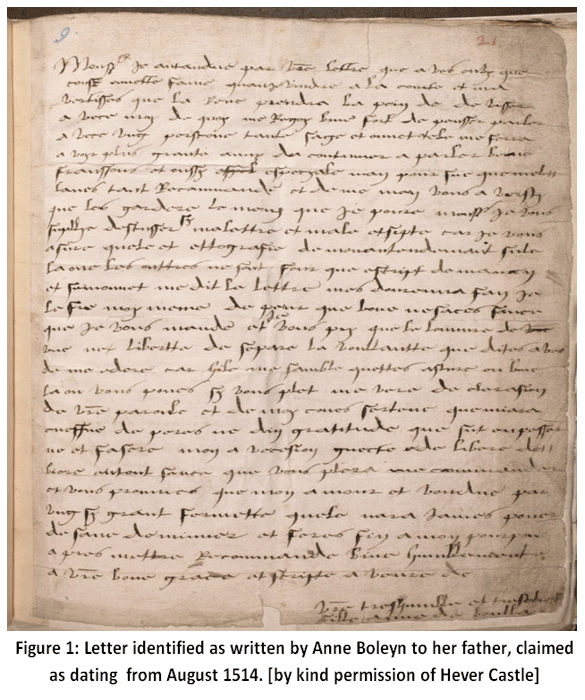 | Figure 1: Letter identified as written by Anne Boleyn to her father, claimed as dating from August 1514. [by kind permission of Hever Castle]
|
The letter is written in French and is held by many as proof that Anne was born in 1501. Paget argued that the letter could not have been written by a young person (aged 7 or 8 if born in 1507) and that 1501 was thus a more likely date of birth, making Anne then about 13 years old in 1514. Ives also concluded that the letter was ‘in the formed hand of at least a teenager’; and that an age of 13 years might also have been more likely in terms of the practice of sending daughters of the English aristocracy for ‘training’ in continental courts (Ives, 2008,15).However, this does not quite seem to fit. If born in 1501, Anne would have been at least 21 by the time she returned to England (1522) which seems rather old to start seeking a position at the English court and a prestigious marriage. For example, Henry VIII’s grandmother Margaret Beaufort was married, pregnant then widowed by the age of thirteen; Margaret of Austria was sent to France as an intended bride at the age of three, and was married at seventeen. The consequence of a 1501 year of birth would also be that Anne was a ‘middle-aged’ thirty-two when she married and 36 when she died. Warnicke, Russell and others continue to support the original idea of Anne’s year of birth as 1507 (Warnicke, 2009, Russell, 2010). Warnicke comments that the dating of the letter is speculative and letter is poorly written 'extremely bad handwriting ... like that of a small child'. The writer apologises for errors and refers to assistance received from her tutor (Norton, 2013). More significantly, and what appears not to have been queried before, is that the handwriting itself does not seem to have been examined or verified and is nothing like Anne’s later handwriting (Figure 1). Paget does not contemplate or discuss the actual handwriting at all.
It seems strange that the evidence of a single undated letter should outweigh a significant number of written statements. Especially when the handwriting itself does not seem to have been seriously investigated and (even though ending with her name) does not correspond to autograph documents by Anne. Anne Boleyn’s life and memory was very much obliterated by Henry and others after her death. Few documents survive which is surprising considering that she was known as a prolific letter writer and it seems likely that many of her writings were destroyed intentionally.4 Apart from Henry and Thomas Cromwell taking such steps, others would not wish to be caught with the writings of an executed adulterer and traitor. But autograph documents and fragments do survive, such as her annotations on the two Books of Hours now at Hever Castle. On the Book of Hours (Bruges 1450), Anne’s inscription reads ‘Le temps viendra … je anneboleyn’ [the time will come] (Figure 2).
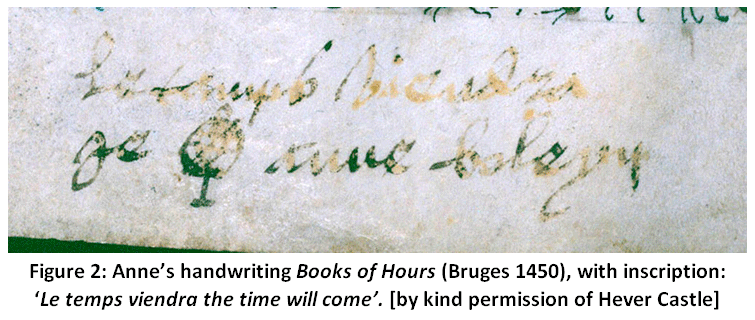 | Figure 2: Anne’s handwriting Books of Hours (Bruges 1450), with inscription: ‘Le temps viendra the time will come’. [by kind permission of Hever Castle]
|
On another Book of Hours (Paris 1528), a note addressed to Henry in a script that matches Figure 2 encourages him ‘remember me when you do pray/That hope doth lead from day to day, anneboleyn’ (Figure 3). Both samples are currently displayed at Hever Castle, Anne’s childhood home (Ives, 2008). Recent research shows that these items were passed down through trusted friends and relatives (Hever Castle and Gardens, 2021).
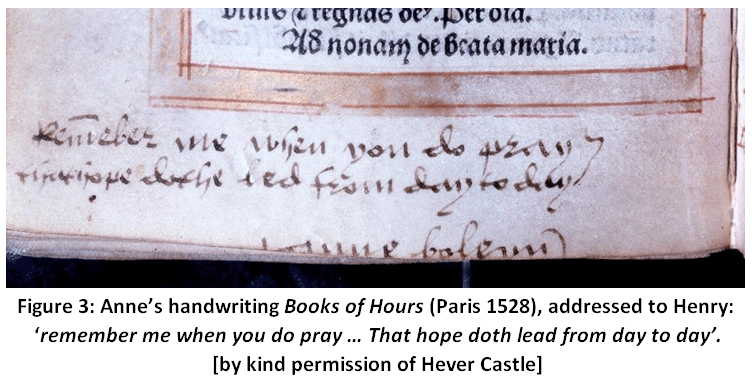 | Figure 3: Anne’s handwriting Books of Hours (Paris 1528), addressed to Henry: ‘remember me when you do pray … That hope doth lead from day to day’. [by kind permission of Hever Castle]
|
The characteristics of a person’s handwriting are normally determined at a young age and the strong oblique slanting letters that really leap off the page in the letter of 1514 (Figure 1) are very different from later verified handwritten texts by Anne – not, as Ives argued, ‘the formed hand’ of a teenager (Ives, 2008, 11). Surely some trace of these traits would come through as she grew older? The dating and subsequent deductions appear plausible at first but seem to have overlooked any detailed comparison or analysis of the handwriting. It was argued by Paget in 1981 that Anne could not have written the letter at Figure 1 at the age of 7, but it does not seem to have been considered that, although having her name at the bottom, it might not have been written by her at all? The findings of a handwriting expert seem necessary before the ‘1514’ letter can be verified as written by Anne, since key handwriting characteristics normally carry through into later life. The spacing and ‘tightness’ of scripts is also as significant, in the forensic examination of handwriting, as the formation of individual letters (Morris, 2021; Huber et al, 1999). It does seem unlikely that Figure 1 was written by the known author of Figure 2 and Figure 3.5 It is quite possible that Anne may have been assisted by her tutor or even had the use of a scribe. The letter itself mentions Semmonet, a tutor, and it is known that he wrote out letters in French for Anne to copy. The author of the letter makes a point of indicating that the script was by the signatory, not the tutor. This seems unnecessary unless the letter under discussion was actually the version written by the tutor Semmonet for Anne to copy – which is entirely possible (Paget, 1981).6
Evidence is lacking for the letter (Figure 1) as being Anne’s own autograph work, or even its date, and no formal comparisons with other writings by her appear to have been made. The letter is written as if from Anne to her father, covering topics about learning French and her spelling etc, but it is undated and does not seem to align with Anne’s later handwriting. The evidence of the letter therefore seems inconclusive and rather ‘shakey’ to say the least. What is even more striking, when contemplating whether it might have been transcribed or written by another (possibly Semmonet) is a comparison with letters verified as being in her father’s handwriting. Thomas Boleyn’s letter to Cardinal Wolsey dated 30 July 1519 (Figure 4) concerning the arrangements to be made for the celebrated ‘Field of Cloth of Gold’ immediately stands out as having very similar handwriting to that of the letter supposedly written by Anne to him.7
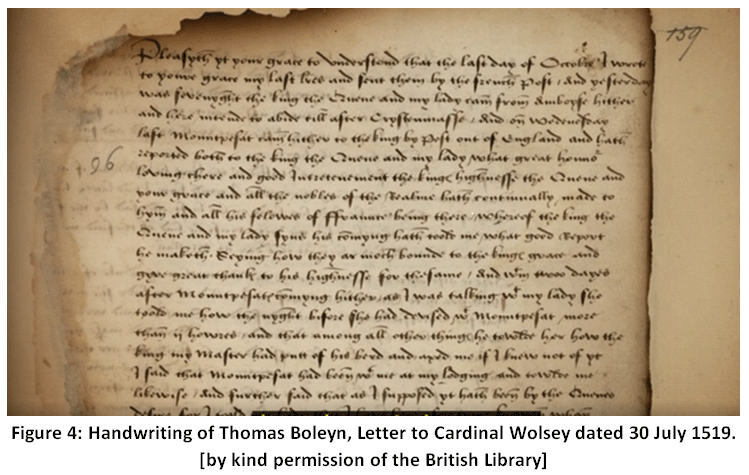 | Figure 4: Handwriting of Thomas Boleyn, Letter to Cardinal Wolsey dated 30 July 1519. [by kind permission of the British Library]
|
Figure 1 seems to resemble Figure 4 far more closely than either Figure 2 or Figure 3. The characteristic and dominating slanting line is clear in both Figure 1 and Figure 4. Although the evidence is not conclusive. Another explanation might therefore be that Thomas had written out such a letter in order to boast of his daughter’s cleverness and progress on the continent, paving the way for her return to England at a suitable time in order to conclude a suitable marriage match for her with a member of the nobility, as indeed nearly occurred (Ives, 2008; Starkey, 2004).8 With Thomas Boleyn’s reputation as a braggart, and so ambitious for his children, it seems entirely possible that the true authorship of the written version was fabricated in this way. The letter could easily have been written by someone else and it is not confirmed that Figure 1 was written by Anne. Discounting the letter as unverified and inadmissible evidence, and reverting to the previous contemporary chronicles giving Anne’s birth year as c 1507, this would leave Anne once more as in her late teens at the time of her return to England and ‘not yet 29’ when she was executed, rather than a matronly 35 or 36 (if born in 1501).
Anne’s date of birth is really significant. If she was born in 1501 then she was already mature (21 or 22) when she first met Henry at Easter 1522; already 26 when Henry first proposed to her (1527); and an aged 32 at her first pregnancy. She would also have been 35 rather than 29 in the year of her last pregnancy and execution (still well within childbearing years) in 1536. Is it really likely that the young Henry would have become so besotted with one who was already around 25 years old when he started courting her? This would have been regarded as distinctly old at the time, especially when bearing in mind the marriage ages of her mother (c 18 years) and sister (c 19), and the fact that Henry’s first wife was on her second marriage by the age of 23 (Catherine of Aragon, was born 1485, married Arthur in 1501 and Henry in 1509). Perhaps a year of birth in between 1501 and 1507 (possibly around 1505/6?) is in fact the most probable – but unresolved issues concerning this letter demonstrate that Anne’s date of birth is worthy of further investigation and discussion.
The Handkerchief, and the determination of Anne’s guilt
A second enduring mystery is whether Anne was actually guilty or not of the crimes levelled against her, particularly adultery. Since Anne was in many ways effectively written out of history, records of her trial and all the ‘evidence’ did not survive, only the indictment (Brewer et al, 1862; Warnicke, 2009).Although the court records of Anne’s trial did not survive, the ‘Middlesex’ (and ‘Kent’) Indictments were preserved. In addition to adultery, she was also accused of treason and plotting the king’s death, but not witchcraft as is often supposed. This is linked to the controversial question of whether it was Henry who decided to get rid of her, or whether it was Cromwell who manoeuvred Anne’s downfall after persuading Henry that it was necessary.
It is often suggested that Anne’s miscarriage in January 1536 was the final straw for Henry, after which he determined to have her removed (Starkey, 2004; Gunn, 1995). By that time, Henry was well into his forties and desperate for a male heir (Shrimplin, 2019; Shrimplin et al, 2021). Concern over a serious jousting accident in which Henry nearly died supposedly caused Anne’s miscarriage but there is considerable evidence that relations between the couple survived these tragedies. Henry’s letters show how much he had truly loved Anne, surmounting seemingly impossible obstacles to make her his wife, and there is evidence that this relationship continued on positive terms for several months January-April 1536.
Anne would have spent February recovering from her January miscarriage, reassuring her husband that she could have another child since she fell pregnant regularly and quite easily. Henry had had a serious brush with death himself and was becoming increasingly worried about his lack of a male heir, crying ‘I see that God will not give me male children’, but there is no real evidence that Henry simply intended to dismiss her if there was no male heir this time (Ives, 2008).
Their continued good relationship in early 1536 is indicated by that fact that Henry and Anne spent the early spring together at Greenwich Palace, when clothes, material and books were still gifted in large quantities to Anne. They spent time with the Princess Elizabeth at Eltham Palace nearby when Henry showered gifts and clothes on his little two-and-a-half year old daughter. Special May Day celebrations were planned, after which Henry and Anne were to leave for Calais on 2 May, so her position still seemed secure. In addition, Acts of Parliament were passed granting property to Anne, her brother and father, as late as early April that year, showing that Henry had not yet taken against her at this time (Ives, 2008, 321).
Cromwell, however, needed to be reckoned with. Although Anne and Cromwell had got on well at first, they increasingly quarrelled. On 2 April 1536, Anne’s Almoner, John Skip, preached a sermon warning against evil counsellors, and hinted that money from the dissolution of the monasteries should be used for education and to help the poor. This was an undoubted criticism of Cromwell, but Skip survived (Ives, 2008; Starkey, 2004).9 Further complications followed when Cromwell’s proposals for an Imperial Treaty with the Emperor Charles V were rejected by Henry (14-17 April 1536) for which Cromwell blamed the pro-French Anne. She had to go. The dominant issue in April 1536, of whether to pursue either an Imperial or French Alliance, no doubt caused friction between Henry and Cromwell, but Henry’s relations with Anne still seemed agreeable. At Easter (16 April), Henry publicly endorsed Anne’s position and ‘openly committed himself to Anne during the Easter celebrations’. Additionally, on the following Tuesday, 18 April, the Imperial Ambassador, Chapuys, who previously refused to acknowledge ‘Anne the concubine’, was caught off guard as Anne accompanied Henry in the Royal Chapel at Greenwich and bowed to Anne, thereby implying recognition (Ives, 2008, 313, 321).
The situation did not start to change until the very end of April 1536, by which time Henry was also taking notice of Jane Seymour. On 23 April, Henry passed over Anne’s brother for the Order of the Garter, then on 24 April, at Cromwell’s instigation, a patent of ‘oyer and terminer’ was issued to investigate charges of adultery and treason against Anne and others. Henry did not actually sign this, and appeared not to take it too seriously because the very next day (25 April) he wrote to Richard Pate, the English Ambassador in Rome, still referring to ‘the likelihood and appearance that God will send us heirs male’ and describing Anne as ‘our dear and most beloved wife’ (Ives, 2008, 321).
Still following Anne’s suggestions, Henry also personally signed documentation concerning the conditions for an Anglo-French (not Imperial) pact on Sunday 30 April. The French diplomat, Lancelot de Carles also observed at this time that Henry behaved as if his relationship with Anne would continue (Ives, 2008, 322, 414). It was noted that, even after the oyer et terminer (not signed by Henry), he ‘treated her as if he had no cause for displeasure and showed her … that she was more than ever dear to him’. And yet, that weekend Henry suddenly and fiercely moved against his wife. What might have suddenly made Henry so angry with Anne and convinced him that she was guilty of adultery and that the marriage now had to end? The ‘last straw’ cannot simply have been the miscarriage of the previous January. And what was the role of Cromwell?
‘Othello Syndrome’ (OS) in modern psychology is defined as ‘a type of paranoid delusional jealousy, characterized by the false absolute certainty of the infidelity of a partner, leading to preoccupation with a partner’s sexual unfaithfulness based on unfounded evidence (Kataoka et al, 2018). In addition, it has also been observed that ‘The Othello syndrome, or delusional jealousy, often raises significant forensic issues, particularly dangerousness. Dangerous patients suffering from the Othello delusion may present with hostility ranging from verbal threats to homicidal acts’ (Leong et al, 1994). This bears more than a passing resemblance to Henry’s behaviour. Could it be that interpretation of Henry’s behaviour in terms of what is now termed ‘Othello Syndrome’, far from being anachronistic was actually the origin of the idea.
It has not previously been pointed out that Henry appears similar in character and behaviour to the warlike and authoritarian yet naïve and simple Othello, whilst Cromwell seems to share characteristics with his scheming ensign Iago. Like Othello, Henry was very good at feeling sorry for himself and seeing himself as the ‘victim.’ Briefly, in Shakespeare’s play, Iago persuades Othello to be suspicious of his wife Desdemona, accusing her of having an affair with Cassio. He successfully sows the seeds of doubt in Othello's mind, inevitably sealing Desdemona’s fate. Enraged and hurt, Othello suddenly resolves to kill his wife. The descent of the charming, innocent and confused Othello from swaggering hero to paranoid killer seems entirely credible.
Shakespeare’s Othello was based on the story Un Capitano Moro (‘A Moorish Captain’) by the Italian writer Giraldi Cinthio (in his Hecatommithi, published 1565), but he significantly changed some of Cinthio’s version which in fact makes it align better with the story of Henry-Cromwell-Anne (Taylor, 1885). The ending, for example, is significantly different. In Cinthio’s version, Othello murders his wife jointly with his ensign, and they get away with it. Only later does Othello regret his action and come to hate the ensign whom he demotes; they both eventually die much later. By contrast, Shakespeare’s Othello experiences far more remorse. Shakespeare appears to have taken the existing material, adopting and adapting it to tell story the story of Henry VIII and Anne Boleyn. Written near the end of Queen Elizabeth’s life (usually dated c 1601), it seems entirely possible that Shakespeare wrote the story in such a way that it was really about, or at least alluded to, the story of the Queen’s parents. Most significantly, a handkerchief features in the actions of Anne Boleyn as well as for Desdemona (Bate et al, 2009; Honigman, 2001). The earliest recorded performance of the play was 1604, but it would obviously have been written earlier in the 1600s (when Elizabeth’s imminent death in 1603 would of course have been unknown).
Like Othello, Henry would have been furious to think he had been cuckolded by his wife. Even Chapuys commented that no reasonable man would talk so much about how he had been cuckolded so often. Like many psychopaths and people with personality disorders, if nothing is going right, the strong tendency is to blame others. It must be everybody else’s fault. In this way, like Othello, Henry was to accuse his wife of having had hundreds of lovers. Cromwell’s behaviour can also be likened to Iago’s. Could it be that it was at this time, on the fateful last weekend of April 1536, that Cromwell whispered (Iago-like) in Henry’s ear about Anne’s adulterous behaviour. Cromwell had the 'oyer and terminer’ ready by 24 April 1536 but could not put it into practice. Then ‘evidence’ about Anne mounted suddenly that last weekend of April. On 29 April, the young Smeaton was overheard expressing his calf-like devotion to Anne which she rejected. More seriously, on the evening of Saturday 29 April, after Sir Henry Norris expressed his admiration for her in a ‘courtly fashion’, Anne joked that he must be looking for ‘dead men’s shoes’ suggesting that if anything happened to the King, Norris would like to marry her. Knowing that wishing or even thinking about the King’s death was treason, Norris was horrified. He swore an oath that no impropriety had taken place (as did Cassio: ‘I never gave you cause’ Othello, V, ii, line 337), while Anne rushed off with the Princess Elizabeth in her arms to swear her faithfulness to Henry. This was described by Alexander Ales to Elizabeth herself in 1559: ‘Never shall I forget the sorrow I felt when I saw the most serene Queen, your mother, carrying you, still a little baby, in her arms.’ One can only imagine the traumatic effect of this on a child just a few months short of her third birthday. (Norton 2013, 323-332; Ives, 2008, 325).
Anne’sbehaviour with Norris, the game of courtly love that had first attracted Henry to her, was inappropriate for a married woman but nothing more. Yet it made her look very guilty in the eyes of her obsessive, narcissist, psychopathic husband. For Cromwell, to play the adultery card, involving the powerful Sir Henry Norris, Anne’s own brother and other men of the Boleyn faction, seemed a great way of taking them all out, together (Ives, 2008).10 Just like Iago, Cromwell would tell Henry that Anne had been unfaithful and he could now prove it. On Sunday 30 April, Cromwell invited Mark Smeaton to his house to have him interrogated about his adultery with the Queen. Smeaton admitted his guilt and also incriminated others (probably under torture) and was taken to the Tower next day (1 May). Smeaton seems to be a weak ineffectual figure with a major crush on Anne, in the same way that Roderigo was similarly in love with Desdemona. It seems possible that Shakespeare modelled the additional figure of Roderigo (not featured in Cinthio’s version) on Smeaton – a very Roderigo-like figure.
These events seemed on the weekend of 29-30 April to have caused Henry to experience a sudden and violent mood swing. The planned departure of Henry and Anne via Dover for Calais on 2 May to meet the French King was suddenly cancelled at 11 pm on Sunday 30 April (Starkey, 2004, 568). The May Day celebrations for Monday 1 May went ahead, attended by Anne, Henry and some of those who were to be accused. Again, still further evidence of Anne’s alleged guilt materialised that day in the form of a specific artefact – in fact a handkerchief. Just like Desdemona, Anne had a handkerchief that she gave away to a supposed lover. As recorded by the pro-Catholic Nicholas Sander in his Rise and Growth of Anglican Schism(published 1585), this was a major precipitating factor for Henry’s behaviour:
On that day, he [Henry] was present at a tournament held at Greenwich, and saw Anne Boleyn who was at a window looking on, drop her handkerchief that one of her lovers might wipe his face running with sweat. Thereupon, the king rose in a hurry, and with six attendants went straight to Westminster. (Sander, 1585, 24; Ives, 2008, 322).
Henry thus finally became convinced of Anne’s guilt when she threw her ‘lover’ a handkerchief to mop his brow after the exertions of the tournament. Although written later, Sander relates an existing story for which there would have been multiple witnesses (as well as Henry himself). As in Othello, the handkerchief was much more than a simple artefact or token of affection. To Othello, it symbolised fidelity and his gift of it to Desdemona confirmed that he would be true to her, presuming that she will be true to him (Othello, V,ii, line 55). Shakespeare makes the handkerchief a major plot device because Iago asserts that Desdemona had given it to Cassio (Othello, IV,i, line 11f). In the same scene, Iago tells Cassio that ‘She gives it out that you shall marry her’ which was overheard by Othello and very much like the accusation against Norris. A similar gesture came back not just to haunt Anne but seemingly as a final piece of evidence for Henry that was to lead to her conviction and execution. The symbolism of the handkerchief that linked poor Desdemona to Cassio, is pivotal to Othello (see Figure 5).
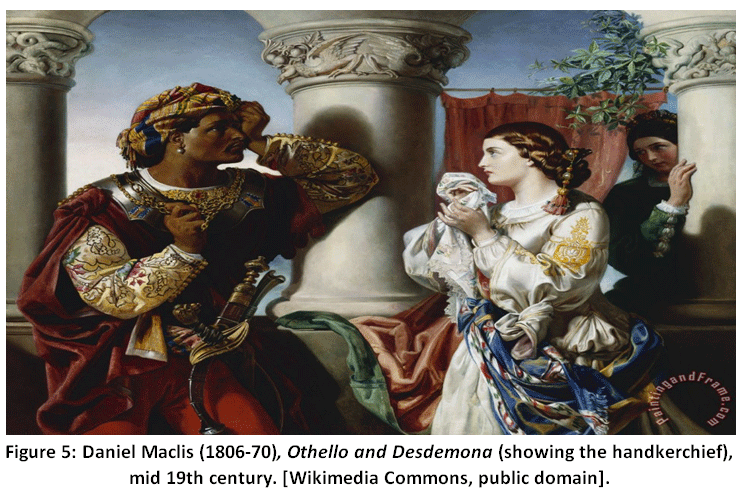 | Figure 5: Daniel Maclis (1806-70), Othello and Desdemona (showing the handkerchief), mid 19th century. [Wikimedia Commons, public domain].
|
It is echoed in the story of the handkerchief that Anne gave to her own alleged lover at the tournament on Monday 1 May 1536. The jousting took place but then something clearly angered Henry who left abruptly. Anne might well have realised she was in serious danger or, like Desdemona, assumed that her husband’s unfounded anger would pass. Like Desdemona, Anne was found guilty on the flimsiest of evidence and killed/executed for unproven crimes.
Desdemona, of course, did not even have the semblance of a trial. Nor did Cassio. But in the same way that Henry presumed Anne’s guilt (sending for an expert swordsman from France on 18 May before his wife’s trial was completed), Othello at once resolved ‘Yet she must die, else she’ll betray more men’ (Othello, Vii, line 6). On 18 May, Anne swore on the sacrament on peril of the damnation of her immortal soul that she had never been unfaithful to the king (Ives, 2008, 356), just as Desdemona averred ‘guiltiness I know not’ in her final scene (Othello, Vii, line 43), which could be read as an encounter between Henry and Anne (devised for Elizabeth’s benefit).
Likewise, at the point of death, Anne exonerated Henry from blame, saying in her final speech on the scaffold ‘I pray God save the King and send him long to reign over you, for a gentler nor a more merciful prince was there never, and to me he was ever a good, a gentle, and sovereign lord… And thus I take my leave of the world and of you all and I heartily desire you all to pray for me’ (Ives, 2008, 358). The dying Desdemona also insisted ‘a guiltless death I die’ (Othello, Vii, line 142), saying with her last breath that her husband was not to blame – ‘Nobody only I myself. Farewell; Commend me to my kind lord; O farewell’ (Othello, Vii, line 144).
The day after the joust/handkerchief incident, 2 May, Anne was taken by barge to the Tower and Henry never saw her again. In just seventeen days, between 2 May until 19 May 1536, Anne was imprisoned, tried, found guilty and executed. It is uncertain whether Henry later suffered any remorse, but Shakespeare’s changing the traditional story of the Moor of Venice to a much more remorseful Othello – ‘one that loved not wisely but too well’ (Othello, Vii, line 387). Othello’s final declaration, ‘I kiss’d thee ere I killed thee’(Othello, Vii, line 403), seems so like Henry and Anne, and hinting that Henry was also very remorseful, which would possibly be of some comfort to Elizabeth.
Just as Iago’s motivation remains a mystery, so is Cromwell’s motivation for convincing Henry that Anne had to be removed. Cromwell hated Anne for her huge influence on Henry; for her speaking out against corruption and state take-over of the wealth and lands of the monasteries; and for her interference in diplomacy and political alliances. He decided that she was a major threat and seemed to have developed his plan for her removal, whilst allowing Henry (Othello-like) to think it was his idea. Iago is the archetypal villain who manipulates all other characters, controlling and persuading them in an intricate web of deceit. He plays on others’ weaknesses while they refer to him as ‘honest’ Iago, thus increasing his control over them – characteristics that seem to be shared by Cromwell.
Henry was all powerful but Cromwell’s Iago-like hint, that not only was Anne guilty but he had the evidence to prove it, convinced him over that fateful weekend that she had been unfaithful. Whether it was because the unbalanced Henry had at last made up his mind, or because Cromwell with ruthless efficiency now proceeded as the main architect of Anne’s downfall, the die was cast. The precipitating factor was not so much the January miscarriage (Henry’s disappointment suggests there was no suspicion of adultery at this time), but Henry’s general paranoia and ability to be swayed when Cromwell, sometime between the 25 April letter to Pate and the 30 April cancellation of trip to Calais, convinced him that Anne had made a fool of him through her multiplicitous adulterous behaviour.
In just a few days, the warrior-like but rather naive and simple Othello was convinced by the cunning, plotting Iago that his wife Desdemona had been unfaithful to him. Over the course of 29 April to 1 May (described by Ives as ‘that single violent weekend’), the warrior-like but also sometime rather naive and simple Henry VIII was convinced by the cunning, plotting Cromwell that his wife Anne Boleyn had been unfaithful to him (Ives, 2008, 333). Short of the discovery of handwritten notes by Shakespeare, it is difficult conclusively to prove that Shakespeare was cryptically referring to the Tudor Royal couple in his play. Analogies were often made in his plays, however, between the present and the past. Other works by Shakespeare also seem to allude to Queen Elizabeth’s family. For example, Elizabeth herself is reputed to have remarked that Shakespeare’s Richard II (which deals with rebellion against a ruler) alluded to her: “I am Richard II, know ye not that?”. The focus of the fictional play The Tempest lies firmly upon accounts of much earlier sixteenth-century travel to the New World, with consequent encounters with more primitive cultures, in the form of Caliban, especially Vi, lines 183-4 and V I, 275. (Righter, 1968).
In both cases of tragedy caused by sexual jealousy, the giving of the handkerchief seems to be the final evidence to indicate that Shakespeare had the Henry-Anne saga in mind as he wrote the play Othello. The analogy with Othello does not only rest on the handkerchief but on the general hypothesis of the similarities between the stories of ‘blustery’ military men, convinced by sinister associates to accuse their wives of adultery with inadequate evidence. The passion of love can turn to murderous rage; the greater the love the greater the pain.11 Othello was performed for Queen Elizabeth when she was nearing the end of her life and perhaps the analogy with her mother’s innocence and her father’s remorse was intended to cause her some quietude as she neared the end. It seems more than possible that, in Othello, Shakespeare was writing of the horror of the ‘execution’ by her husband of the wife of a powerful but inept leader in defence of Anne for the benefit of her daughter Queen Elizabeth. And that Othello-Iago-Desdemona-Cassio-Rodrigo alludes to Henry-Cromwell-Anne-Norris-Smeaton. Is Shakespeare’s Othello really about Henry VIII and Anne Boleyn? The parallels, in particular the inclusion of a handkerchief, demonstrate that this merits consideration.
The Tablecloth, and the Legacy and Impact of Anne Boleyn on her daughter
The role of Anne in framing the outlook and career/activities of her daughter Elizabeth is hard to determine. Had Elizabeth been a boy, Henry’s efforts to abandon Catherine of Aragon in order to find a suitable fertile, intelligent and attractive mother for his heir would have been vindicated. Nevertheless, it was not to be and when Elizabeth’s mother was executed at the will of her father (when she was not yet aged three), it would be enough to cause anyone serious psychological problems. As we know from Freud and other psychological theorists, the influence and presence (or absence) of the mother is immensely influential in the formation of character and life-long approaches to a child’s behaviour and standpoint (Freud, 1905). Freud formulated what had seemingly always existed in human nature in terms of unconscious thoughts and feelings. So it is thus not anachronistic to apply his theories to earlier behaviours, in particular his ideas of the mother as major influence on her children in terms of their emotional, social and physical growth. Freud emphasised that anxiety in children is an expression of the fact that they are feeling the loss of the person they love.
It is true that members of royalty and nobility in the Tudor period would have had limited direct daily contact with their offspring. Absentee parents can also have an effect and the underlying psychological influence of the situation in which they had grown up from childhood would exist. Formative years can have a significant effect on future behaviour and ‘Tell me about your mother’ has been a byword for psychologists from Freud onwards. Indeed, what effect might the loss of his mother Elizabeth of York (in 1503), have had on the eleven-year-old Henry?
Born on 7 September 1533, Elizabeth’s would not have had extensive daily contact with her mother in her early years, being cared for by wet nurses, ‘rockers’ and ‘cleaners’, as was customary. She was sent to a separate household in Hatfield (just north of London) when a few months old. This was largely for her own safety, away from the diseases and ‘foul air’ of London and she would not have seen a great deal of her mother at this time. However, Anne maintained close contact with Elizabeth’s nurse Lady Margaret Bryan when they were apart and often visited her daughter at Hatfield until, aged seven months, Elizabeth was moved near Greenwich Palace (March 1534) where her parents lived. They spent a lot of time with Elizabeth at the adjacent Eltham Palace and she would have seen her parents almost daily. Henry was recorded as being very fond of her, whilst Anne’s financial accounts showed that she personally specially ordered many fabulous items for her daughter (Ives, 2008, 255-56, 266-67; Starkey, 2004, 511-12).
Elizabeth was at the Court with her parents for five weeks in the first quarter of 1535, and also during Christmas 1535. She was still there at the end of January 1536 and Henry paraded his daughter around in celebrations on the death of Catherine of Aragon. Elizabeth was at Court again in April 1536 and the description of Anne holding Elizabeth in her arms while she pleaded with her husband about her innocence survives. This must have been extremely traumatic for the young girl, as she was reminded of this in 1559 by Alexander Ales, as mentioned above. It seems extremely probable that Elizabeth’s loss of her mother (the circumstances becoming clear to her as she grew older) would have had a profound effect on her life and mental state. Is it any surprise that Henry and Anne’s daughter Elizabeth did not marry, when her father had executed her mother? Even now, young people are sometimes reluctant to marry if their parents have divorced; the things that happen to us make us who we are, particularly in terms of our relationships with others.
Anne was fiercely protective of Elizabeth’s rights and inheritance and held her daughter’s well-being uppermost in her mind. This was demonstrated by her actions directed at ensuring her daughter’s legitimacy and right to the succession, whatever happened to Anne herself. Anne foresaw that her child would have a difficult time, and indeed Elizabeth was declared illegitimate, disinherited, imprisoned and at risk of death during the reigns of Edward VI and Mary I, before becoming Queen on 17 November 1558.
On 26 April 1536, just days before her arrest, Queen Anne Boleyn met with her chaplain, Matthew Parker and asked him to watch over her daughter, the Princess Elizabeth, if anything happened to her. In other words, Anne was entrusting him with her daughter’s spiritual care. She wished to ensure her daughter was looked after even if, as seemed likely at the time, she would not become Queen. Parker kept his promise and Elizabeth eventually appointed him as key adviser and Archbishop of Canterbury in 1559. Parker later told Elizabeth’s first minister, William Cecil, Lord Burghley, that he would not have accepted if he ‘had not been so much bound to the mother’ (Warnicke, 2009, 238f). He was committed to looking after and supporting Anne’s daughter. As well as the promise extracted from Parker to ensure Elizabeth’s education and upbringing, Anne also ensured that her daughter would become guided by a whole group of senior theologians and academics with solid interests in the ‘New Learning’, humanism and reform. Men like John Cheke, Roger Ascham, William Cecil and John Dee became bound to Elizabeth (in some cases acting as her tutor), and it was upon such men that she relied when she finally became Queen of England in 1558.
Anne had refrained from speaking out against her husband, even when facing execution – taking care, even on the scaffold, not to say anything that could endanger her daughter, physically or in term of her inheritance. She was right, because Elizabeth was seriously neglected after her mother’s execution and her life even put at risk. Elizabeth would have realised and recalled this as she became adult, especially since her carers, such as Lady Bryan, were linked to the Boleyn family. As Queen, Anne could never have been a hands-on mother, but she made provision (prior to her own death) for her daughter’s education as she grew up. She was involved as much as she could be. Elizabeth acknowledged this, as shown for example, at her January 1559 coronation when various pageants were staged, at least one of which (at Gracechurch St) proudly included Elizabeth’s family tree with the characters of her parents Henry VIII and Anne Boleyn seated and dressed as King and Queen, husband and wife, with their names and titles written out. This drew attention to her mother and father together, not hiding the fact that she was Anne’s daughter.
Elizabeth carried the memory of her mother with her during her life – as shown by her ring, bearing their joint portraits. The ‘locket ring’ is made up of small diamonds, rubies and pearl. It opens to reveal miniature portraits of which one is clearly Elizabeth I, whilst the other woman, wearing a French hood of the type worn by Anne Boleyn and dress of the 1530s, is generally accepted as a portrait of Elizabeth’s mother, Anne.12 It seems that Elizabeth always kept the ring with her. Nor did Elizabeth forget her mother’s co-accused. According to Sir Robert Naunton (1563-1635), Elizabeth also honoured the memory of Henry Norris, considering that he died ‘in a noble cause and in the justification of her mother's innocence.’ Elizabeth remained close to Norris’s son and his wife Margery (Wikisource, 2018)
Elizabeth’s feelings for her mother were also demonstrated in the writings of George Wyatt (grandson of Thomas who knew Anne well) in his The life of the virtuous, Christian and renowned Anne Boleyn. Latimer’s sympathetic treatise on Anne focussed on her charitable work) and Foxe’s Book of Martyrs showed Anne as a heroine and martyr. Elizabeth also made use of her mother’s personal heraldic device of a falcon on some of her personal possessions and a sixteenth-century original carved wooden version of the crowned falcon also recently came to light. Catalogued as ‘an antique carved wooden bird’ when it was auctioned in 2019 (for £75) the carving has now been identified as Anne Boleyn’s heraldic emblem and is on long-term loan to Hampton Court Palace.13 (Historic Royal Palaces, 2023)Elizabeth did not try to hide or ignore her mother and the role she played, but supported her memory. For example, the tympanum at St Margaret Tivetshall, Norfolk (1587) shows the arms of Elizabeth I together with Anne’s crowned falcon(The Norfolk Churches Site, 2018). These devices would not have been used if Elizabeth had not been happy about it and revered the memory of her mother. Anne became rehabilitated under Elizabeth.
Significantly, and what has not previously been pointed out in the literature, the legacy and effect of Anne on her daughter are curiously endorsed by a linen tablecloth which can be considered as evidence of Elizabeth’s support for and devotion to the memory of her mother. The powerful and wealthy financier Sir Thomas Gresham hosted an extensive feast and celebrations when Queen Elizabeth I made a ceremonial visit to his Royal Exchange in January 1571 (Saunders, 1997, 10; Shrimplin, 2017, 49-50). A set of magnificent linen tablecloths was specially made in the Low Countries for this very formal visit of the monarch herself. At the time, one’s linen was like one’s car – expensive woven and embossed cloth made to order in Flanders was the Tudor equivalent of showing off one’s Porsche.
Three of the tablecloths survive – one in the Victoria & Albert Museum, one in the archive of the Worshipful Company of Mercers, and one at Gresham College, Barnard’s Inn Hall, Holborn. (Figure 6).
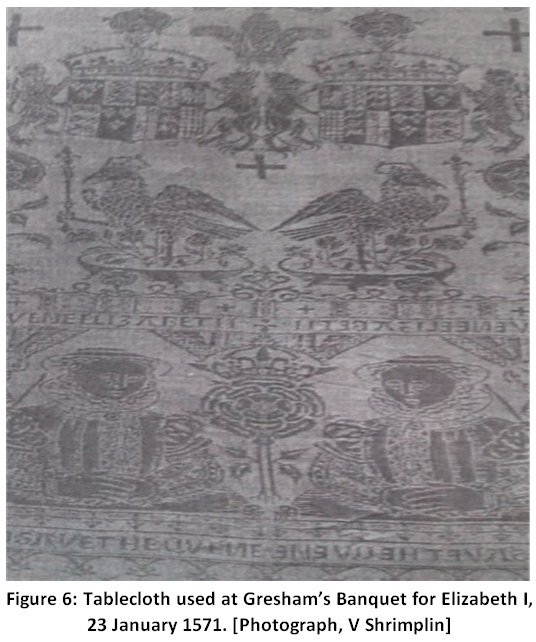 | Figure 6: Tablecloth used at Gresham’s Banquet for Elizabeth I, 23 January 1571. [Photograph, V Shrimplin]
|
The woven design features magnificent portraits of Queen Elizabeth together with Anne Boleyn’s device of a falcon, significantly crowned and holding a sceptre beneath the Royal Tudor arms. Anne’s heraldic device of a falcon and Elizabeth’s fondness for it as a memory of her mother were clearly so well-known that Sir Thomas Gresham used the motif to please Elizabeth and win him favour with her.
The idea is sometimes put forward that Elizabeth distanced herself from Anne Boleyn, embarrassed by the accusations levelled at her mother and her execution. That Elizabeth preferred to emphasise that she was her father’s daughter might have been understandable, given the succession and the fact that her mother’s notoriety was emphasised by later (mostly pro-Catholic) writers. But the evidence provided here shows this not to be the case. Thus a tablecloth can be regarded as further evidence of Elizabeth’s devotion to her mother and the influence that her legacy had on her life. Elizabeth was clearly proud to associate with the memory of Anne Boleyn.
As with any child who loses a parent at a young age, the effect will inevitably be significant. Elizabeth had her mother taken from her because of what is now often considered to be a miscarriage of justice. But she never forgot her and the fact that her love for her mother was very well known is demonstrated by Sir Thomas Gresham proudly incorporating the idea into an extremely significant artefact especially made to please Queen Elizabeth. Elizabeth had shown that far from being embarrassed by her ‘traitor’ mother who was largely written out of history and her memory obliterated, she was proud to be Anne’s daughter. A very special tablecloth bearing reference to her mother seems to have been orchestrated to please Elizabeth.
Comparisons may also be made with the recently discovered artefact of the Heart Pendant and chain on display at time of writing (January 2026) in the British Museum, and marked by a successful appeal to retain it in England(The British Museum, 2018).Made of 24ct gold and enamel, the pendant was found near Birmingham, England in 2019. Dated by the British Museum as 1518, the design shows Henry VIII’s Tudor Rose entwined with Katherine of Aragon’s heraldic motif of a pomegranate, with their initials ‘H’ and ‘K’ and the motto ‘tousiors’ (toujours) together on the obverse(The British Museum, 2025). This artefact has been interpreted as showing Henry’s love for his first wife Katherine – but if commissioned instead by Katherine, it could smack of desperation as she tried to hold on to Henry (when she was 32-33 years old, having produced one healthy daughter from seven pregnancies). It also remains to be seen how it ended up in the remote field where it was found. Henry would undoubtedly have been furious if Katherine had lost it, yet he might have been responsible for throwing it away in anger or despair (his only recognized illegitimate son was born in 1519). Perhaps it had been stolen and abandoned by a thief. It takes time for artefacts to give up their secrets.
Three great unknowns about Anne Boleyn: her age and precise date of birth; the extent of her alleged guilt and whether this was primarily pursued by Henry or Cromwell; and her legacy and impact on her daughter, can thus be explored by considering these three specific artefacts, as well as written sources. The use of actual objects to develop the debate shows how it is possible to speculate on the answers to these questions. The Letter on which the dating of Anne’s birth seems uncertain as evidence of her age; the Handkerchief that Anne supposedly gave to her lover suggests that Shakespeare could well have written Othello with the relationship between Henry-Anne-Cromwell in mind as a parallel to Othello-Iago-Desdemona; and, finally, theTableclothmade specially for Elizabeth and featuring her mother’s heraldic symbol of a falcon further supports the idea of Elizabeth’s pride and affection for the memory and legacy of her mother.
Consideration of actual artefacts is important in historical research, as well as written material.Such an approach is significant in terms of historiography and the history of objects in the early modern period, demonstrating the value of material evidence, and shows that key issues in the story of Anne Boleyn are not unworthy of further investigation.
Acknowledgement
The author would like to thank Hever Castle and the British Library for permission to use photographic images, as indicated.
Funding Sources
The author(s) received no financial support for the research, authorship, and/or publication of this article.
Conflict of Interest
The author(s) do not have any conflict of interest.
Data Availability Statement
This statement does not apply to this article
Ethics Statement
This research did not involve human participants, animal subjects, or any material that requires ethical approval.
Informed Consent Statement
This study did not involve human participants, and therefore, informed consent was not required.
Clinical Trial Registration
This research does not involve any
Permission to reproduce material from other sources
Author Contributions
The sole author was responsible for the conceptualization, methodology, data collection, analysis, writing, and final approval of the manuscript
References
- Eric Ives, The Life and Death of Anne Boleyn ‘The Most Happy’, (Oxford, 2008 edition).
- Elizabeth Norton, The Anne Boleyn Papers: The Complete Letters, Dispatches and Chronicles (Stroud, 2013).
- David Starkey, Six Wives: The Queens of Henry VIII (London, 2004).
- Retha M. Warnicke The Rise and Fall of Anne Boleyn: Family Politics at the Court of Henry VIII (11th ed, Cambridge, 2009), 7-9.
- Retha M. Warnicke, ‘Anne Boleyn's Childhood and Adolescence,’ The Historical Journal, vol. 28, No. 4 (Dec. 1985), 939-952, especially 945.
CrossRef - The Anne Boleyn Files, https://www.theanneboleynfiles.com/[accessed 22 Jan 2026]
- On the Tudor Trail, https://www.facebook.com/OntheTudorTrailRetracingthestepsofAnneBoleyn/ [accessed 30 April 2026]
- The Tudor Society, https://www.tudorsociety.com/[accessed 22 Jan 2026]
- Gareth Russell, http://garethrussellcidevant.blogspot.com/2010/04/age-of-anne-boleyn.html [accessed 22 Jan 2026]
- Henry Clifford, The Life of Jane Dormer, Duchess of Feria, transcribed from the Ancient Manuscript in the possession of the Lord Dormer, ed. Canon E. E. Estcourt (London, 1887), 80.
- William Camden (1615), Annales Rerum GestarumAngliae et HiberniaeRegnante Elizabetha. http://www.philological.bham.ac.uk/camden/lectorieng.html#intro [accessed 22 Jan 2026]
- Eric Ives, The Life and Death of Anne Boleyn ‘The Most Happy’, (Oxford, 2008 edition), 18, 29
- David Starkey, Six Wives: The Queens of Henry VIII (London, 2004), 258-63.
- Retha M. Warnicke The Rise and Fall of Anne Boleyn: Family Politics at the Court of Henry VIII (11th ed, Cambridge, 2009)
- Hugh Paget, ‘The Youth of Anne Boleyn’, Bulletin of the Institute of Historical Research (BIHR), vol 54, Issue 130 (Nov. 1981), 162-170.
CrossRef - Nicholas Sander, The Rise and Growth of the Anglican Schism, Cologne, 1585, (British Library, Sloane MS 2495, f. 2v) Translated by David Lewis, (London, 1877), 25.
- Eric Ives, The Life and Death of Anne Boleyn ‘The Most Happy’, (Oxford, 2008 edition).
- Eric Ives, The Life and Death of Anne Boleyn ‘The Most Happy’, (Oxford, 2008 edition), 15.
- Retha M. Warnicke The Rise and Fall of Anne Boleyn: Family Politics at the Court of Henry VIII (11th ed, Cambridge, 2009), 7-9.
- Corpus Christ College Cambridge MS119, f.21.
- Elizabeth Norton, The Anne Boleyn Papers: The Complete Letters, Dispatches and Chronicles (Stroud, 2013), 33-34.
- British Library, Records and papers concerning England and Rome, 1528-1529; Cotton Vitellius B. XII, f.4.
- Eric Ives, The Life and Death of Anne Boleyn ‘The Most Happy’, (Oxford, 2008 edition), 239-40.
- British Library, [@British Library]. (2015, February 25) See letters by Henry VIII, Anne Boleyn and Thomas More in Treasures Gallery http://bit.ly/15KQzel [X]. https://x.com/britishlibrary/status/570596892809297920
- Hever Castles and Gardens. (2021, May 19). Retrieved January 22, 2026, from https://www.hevercastle.co.uk/news/new-research-anne-boleyn-prayer- book/#:~:text=Hever%20Castle%20 has%20on%20display,led%20 from%20day%20to%20day
- Eric Ives, The Life and Death of Anne Boleyn ‘The Most Happy’, (Oxford, 2008 edition), 11.
- Ron Morris, Forensic Handwriting Identification: Fundamental Concepts and Principles (London, 2nd edition, 2021)
- Roy A. Huber, A.M. Headrick, Handwriting Identification: Facts and Fundamentals (Florida, 1999).
CrossRef - Hugh Paget, ‘The Youth of Anne Boleyn’, Bulletin of the Institute of Historical Research (BIHR), vol 54, Issue 130 (Nov. 1981), 167.
CrossRef - Eric Ives, The Life and Death of Anne Boleyn ‘The Most Happy’, (Oxford, 2008 edition), 34, 63,67.
- David Starkey, Six Wives: The Queens of Henry VIII (London, 2004), 266-67.
- Sir Thomas Boleyn, Letter to Cardinal Wolsey concerning preparations for the Field of the Cloth of Gold. British Library, Paris. RP 2696/2.Retrieved January 22, 2026, from https://searcharchives.bl.uk/primo_library/libweb/action/display.do?tabs=detailsTab&ct=display&fn=search& doc=IAMS041-001597123&indx=1& recIds=IAMS041-001597123&recIdxs= 0&elementId=0&render Mode=poppedOut&display Mode=full&frbrVersion=&dscnt=0&v l(8228361UI0)=any &vl(45770780UI1) =all_items &scp.scps=scope%3A%28BL%2 9&tab=local&dstmp=163109978791 8&vl(freeText0) =thomas%20boleyn%20letter% 20to%20wolsey%20&vid=IAMS _VU2&mode=Basic
- Letters and Papers, Foreign and Domesticof the Reign of Henry VIII (ed. J. S. Brewer et al, 21 vols 1862-1932; ‘LP X 876’). Retrieved January 22, 2026, from https://www.nationalarchives.gov.uk/search/results/?_q=Letters+and+papers+foreign+and+domestic+of+the+reign+of+Henry+VIII
- Retha M. Warnicke,The Rise and Fall of Anne Boleyn: Family Politics at the Court of Henry VIII (11th ed, Cambridge, 2009),203f.
- David Starkey, Six Wives: The Queens of Henry VIII (London, 2004), 554.
- Steven Gunn, ‘The Structures of Politics in Early Tudor England’, Transactions of the Royal Historical Society, Vol. 5 (1995), 59-90.
CrossRef - Valerie Shrimplin (2019), Anne Boleyn London: Pitkin, Pavilion Books, 7.
- Shrimplin, V., & Jayasena, C. N. (2021). Was Henry VIII infertile? Miscarriages and male infertility in Tudor England. Journal of Interdisciplinary History, 52(2), 155–176. https://doi.org/10.1162/jinh_a_01695
CrossRef - Eric Ives, The Life and Death of Anne Boleyn ‘The Most Happy’, (Oxford, 2008 edition), 296f.
- Eric Ives, The Life and Death of Anne Boleyn ‘The Most Happy’, (Oxford, 2008 edition), 321
- Eric Ives, The Life and Death of Anne Boleyn ‘The Most Happy’, (Oxford, 2008 edition), 307f.
- David Starkey, Six Wives: The Queens of Henry VIII (London, 2004), 556-59.
- Hiroshi Kataoka and Kazuma Sugie, ‘Delusional Jealousy (Othello Syndrome) in 67 Patients with Parkinson’s Disease’, Frontiers in Neurology, 7 March 2018.
CrossRef - G B Leong, J A Silva, E S Garza-Trevino, D Oliva Jr, M M Ferrari, R V Komanduri, J C Caldwell, The dangerousness of persons with the Othello syndrome’, Journal of Forensic Science (1994) Nov; 39(6), 1445-54.
CrossRef - Giraldi Cinthio, Un Capitano Moroiter in Hecatommithi, 1565 (trans 1855 by J. E. Taylor). Retrieved January 22, 2026, fromhttps://cpbapse2.wpmucdn.com/ blogs.ststephens.wa.edu.au/ dist/7/1263/files/2015/10/Cinthios-Tale-1rs1kwy.pdf
- Jonathan Bate and Eric Rasmussen, The RSC ShakespeareOthello (London, 2009).
- E. A. J. Honigman (ed.), Othello, Arden Shakespeare (London, 2001)
- Jonathan Bate and Eric Rasmussen, The RSC ShakespeareOthello (London, 2009), 11.
- E. A. J. Honigman (ed.), Othello, Arden Shakespeare (London, 2001), 44-46.
- Elizabeth Norton, The Anne Boleyn Papers: The Complete Letters, Dispatches and Chronicles (Stroud, 2013), 323-332.
- Eric Ives, The Life and Death of Anne Boleyn ‘The Most Happy’, (Oxford, 2008 edition), 325
- David Starkey, Six Wives: The Queens of Henry VIII (London, 2004), 568.
- Nicholas Sander, The Rise and Growth of the Anglican Schism, Cologne, 1585, (British Library, Sloane MS 2495, f. 2v) Translated by David Lewis, (London, 1877), 24.
- Eric Ives, The Life and Death of Anne Boleyn ‘The Most Happy’, (Oxford, 2008 edition), 322
- Eric Ives, The Life and Death of Anne Boleyn ‘The Most Happy’, (Oxford, 2008 edition), 356.
- Eric Ives, The Life and Death of Anne Boleyn ‘The Most Happy’, (Oxford, 2008 edition), 358.
- William Shakespeare, The Tempest, (ed Anne Righter), London 1968.
- Sigmund Freud, Complete Works 1905 (ed J Strachey, 2010). Retrieved January 22, 2026, from http://freudcompleteworks.com/Freud_Complete_Works.pdf)
- British Library, Retrieved January 22, 2026, from https://www.bl.uk/press-releases/ 2021/august/british- library-reveals-autumn-season- highlights?inViewer=imgI D8846350a-3237-4665-a7c8-2c753dbb19a4
- Eric Ives, The Life and Death of Anne Boleyn ‘The Most Happy’, (Oxford, 2008 edition), 255-56, 266-67;
- David Starkey, Six Wives: The Queens of Henry VIII (London, 2004), 511-12.
- Retha M. Warnicke The Rise and Fall of Anne Boleyn: Family Politics at the Court of Henry VIII (11th ed, Cambridge, 2009), 238f.
- Wikisource (2018, August 16). Retrieved January 22, 2026, from, https://en.wikisource.org/ wiki/Page:Dictionary_of_National_ Biography _volume_41.djvu/128
- The Norfolk Churches Site(2018, August) Retrieved 22 January,2026, from http://www.norfolkchurches.co.uk /tivetshallmargaret/tivetshallmargaret.htm.
- Historic Royal Palaces (2023). Retrieved January 22, 2026, from, https://www.hrp.org.uk/media-and-press/press-releases-2022/ anne-boleyn-s-carved-falcon-badge- on-display-at-hampton-court-palace-to-mark -500th-anniversary-of- her-first-encounter-with- henry-viii-following-new-research- linking-rare-architectural-survival- to-palace-s-great-hall/#gs.2cb577
- Anne Loreille Saunders (ed.), The Royal Exchange (London, 1997), 10.
- Valerie Shrimplin, (2017), Sir Thomas Gresham and His Vision for Gresham College, London: Pitkin, 49-50.
- The British Museum, (2018) Retrieved January 22, 2026, from https://www.britishmuseum.org/tudor-heart-appeal
- The British Museum, (2025, May 15) Retrieved January 22, 2026, from https://www.britishmuseum.org/blog/britains-greatest-treasure-finds-everyday-discoveries-reshaping-history
Appendix
1William Camden (1615), Annales Rerum Gestarum Angliae et Hiberniae Regnante Elizabethahttp://www.philological.bham.ac.uk/camden/lectorieng.html#intro, Camden’s Introduction, paragraph 1 and paragraph 5 (where he sees Anne as innocent).
2In fact, Nicholas Sander (to use the more usual spelling) said ‘at fifteen’ Anne was sent to France (almost certainly 1514). Nicholas Sander, The Rise and Growth of the Anglican Schism, Cologne, 1585, (British Library, Sloane MS 2495, f. 2v) Translated by David Lewis, (London, 1877), 25.
3Corpus Christ College Cambridge MS119, f.21; see Ives, Life and Death, 15, and 368n.
4Attempts to destroy the memory of Anne Boleyn are evidenced by the burned fragment of her letter to Wolsey 1528 concerning the annulment of Henry’s marriage to Catherine. An attempt was clearly made to destroy it and the handwriting is confirmed as Anne’s since Henry VIII’s writing is on the same sheet. (British Library, Records and papers concerning England and Rome, 1528-1529; Cotton Vitellius B. XII, f.4). Also https://twitter.com/britishlibrary/status/570596892809297920
5As discussed with Ruth Myers ABFHE WADE CGA, Forensic Handwriting Analyst (personal communication, March 2022).
6Probably Symonnet, a member of Margaret’s household; Paget, ‘Youth of Anne Boleyn’, 167.
7Sir Thomas Boleyn, Letter to Cardinal Wolsey concerning preparations for the Field of the Cloth of Gold. British Library, Paris. RP 2696/2. https://searcharchives.bl.uk/primo_library /libweb/action/display.do?tabs=details Tab&ct=display&fn=search&doc=IAMS041-001597123&indx =1&recIds=IAMS041-001597123&recIdxs=0 &elementId=0& renderMode=popped Out&display Mode=full&frbrVersion= &dscnt=0&vl(8228361UI0) =any&vl(45770780UI1) =all_items&scp.scps= scope%3A%28BL%29& tab=local&dstmp =1631099787918&vl (freeText0)=thomas %20boleyn%20 letter%20to%20 wolsey%20&vid=IAMS_VU2&mode=Basic
8By the standards of Tudor nobility, 22 would have been rather old to begin the quest for a husband. After her return from France, there were possibilities for Anne to marry Henry Percy, heir to the Earl of Northumberland (Ives, Life and Death, 63-67; Starkey, Six Wives, 267-68), or James Butler, heir to the earl of Ormonde (Ives, Life and Death, 34, 65; Starkey, Six Wives, 266-67).
9Skip related the story from the Book of Esther, showing how Queen Esther protected the people contrary to the wishes her husband the King, and resulting in the downfall of the King’s evil counsellor Haman, implicitly alluding to Cromwell. Ives, Life and Death, 307f; Starkey, Six Wives, 556-59.
10 The final list of accused was Mark Smeaton, Sir Henry Norris, Anne’s brother George (Viscount Rochford), Sir Francis Weston and William Brereton. All except Smeaton maintained their innocence and refused to admit to charges of adultery or treason but, in contrast to the commoner Smeaton, they were unlikely to have been tortured. For the vast majority of the times specified when Anne had allegedly been unfaithful, she had alibis demonstrating that she was not even in the same place as her alleged lovers (Ives, Life and Death, 343-45).
11Queen Anne Boleyn is presented in a good light in Shakespeare’s Henry VIII, not seeking to be Queen (Act II, sc iii) and also as the play ends with the birth of Elizabeth (Act V, sc v).
12 The ring is in the collection of the Chequers Trust and was recently exhibited at the British Library.
13For St Margaret’s, see http://www.norfolkchurches.co.uk/ tivetshallmargaret/tivetshallmargaret.htm. For the recently discovered wood carving see: https://www.hrp.org.uk/media-and-press/ press-releases-2022/anne-boleyn-s-carved-falcon-badge-on-display-at-hampton-court-palace-to-mark-500th -anniversary-of-her-first- encounter-with-henry-viii-following-new-research-linking-rare- architectural-survival-to-palace-s-great-hall/#gs.2cb577

This work is licensed under a Creative Commons Attribution 4.0 International License.